

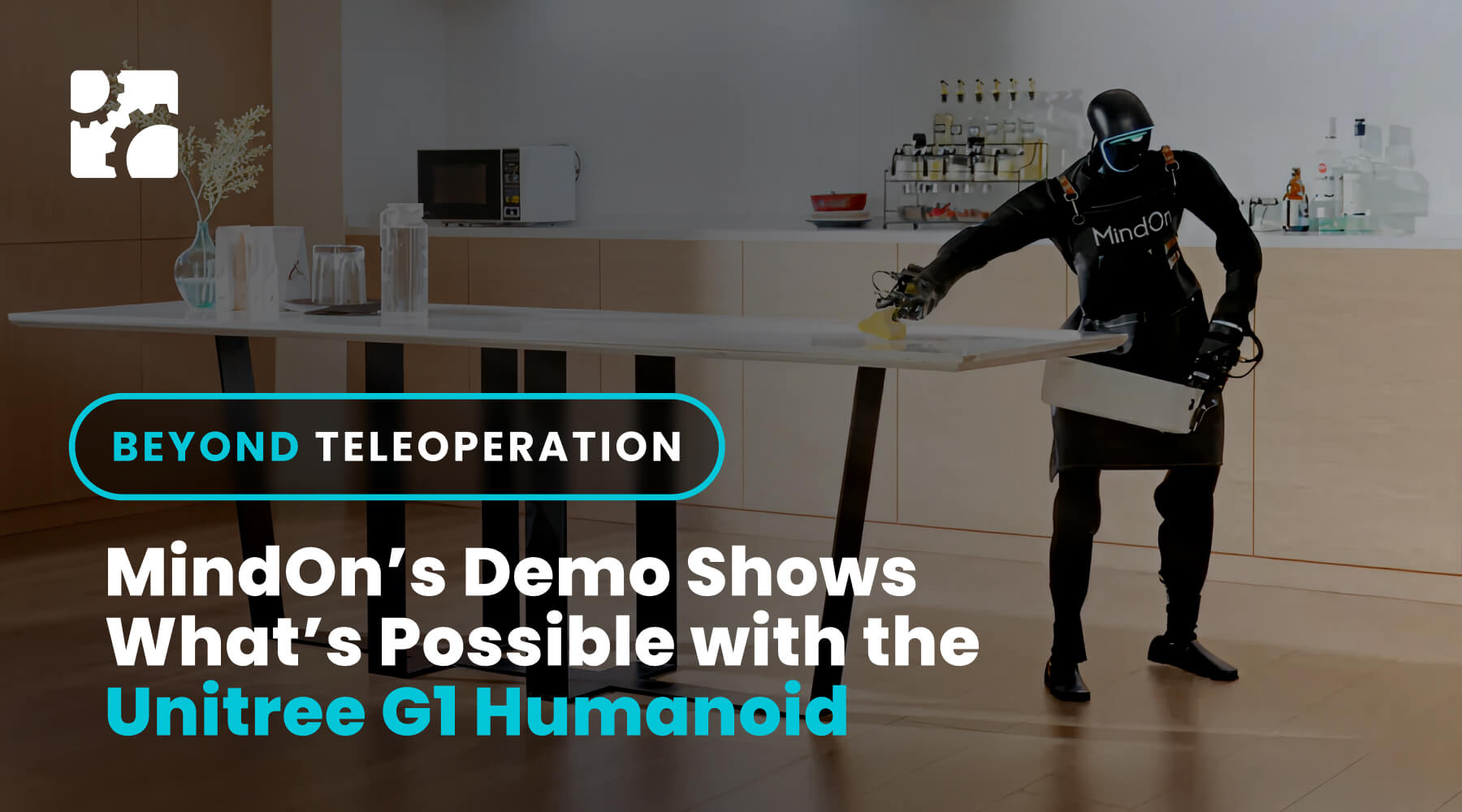
Humanoid robots have been getting a lot of attention lately, especially as more videos show them performing household tasks. The visuals are impressive, but it is important to understand how many of these demonstrations actually work. A large portion of the clips circulating online are not examples of real autonomy. They are examples of teleoperation.
Teleoperation means a human operator is controlling the robot in real time, often from a completely separate location. The robot is not deciding how to move, how to grasp an object, or how to navigate a space. Instead, the movements are being directed remotely. This is useful for testing hardware, collecting data, and producing demos, but it does not represent a robot acting independently.
This is what makes MindOn’s recent video so interesting. Their demo claims to show a Unitree G1 performing everyday tasks without teleoperation. Instead, they state that the robot is running custom software and behavior logic created by their team. In this context, autonomy refers to the robot executing pre-programmed behaviors or perception-driven actions without a human operator steering the robot moment by moment.
If the demo is accurately represented, it shows the type of practical development that moves the field forward. It highlights what can happen when developers use real hardware and build their own capability on top of it, rather than staging teleoperated sequences.
MindOn’s work is a reminder that meaningful progress is already happening on platforms that exist today. It is not dependent on future release dates or promises several years out. It is happening right now on hardware that is already in the hands of researchers.
What Makes the G1 a Strong Platform for Autonomy Research?
The Unitree G1 EDU offers a combination of hardware, sensors, and compute that make it a practical platform for teams working on real autonomy, locomotion, and manipulation research.
-
Robust, production-grade hardware: The Unitree G1 EDU features 23 degrees of freedom, high-torque joint motors delivering up to 90 newton-meters, a 2-kilogram arm payload capacity, and a total weight of 35 kilograms with the battery. It’s engineered as a durable, development-ready platform for real-world research.
-
Strong onboard sensing: The G1 includes a LIBOX MID-360 LiDAR for environmental scanning and an Intel RealSense D435i depth camera for perception, mapping, and object interaction. Together, they provide a solid foundation for autonomy and vision pipelines.
-
Developer-focused compute: The G1 EDU Standard configuration (the entry model recommended model for secondary development) comes with an NVIDIA Jetson Orin NX 16GB module delivering 100 TOPS of compute. This supports advanced AI models, control policies, and custom autonomy stacks running directly onboard.
-
Practical runtime for real experimentation: The system supports up to 2 hours of battery life depending on workload and locomotion style, giving researchers enough operating time to test meaningful behavior sequences without constant recharging.
-
Open development ecosystem: The G1 EDU provides full access to APIs, the SDK, and custom behavior programming, enabling developers to create, modify, and test their own software. It’s exactly the type of environment that teams like MindOn are using to build higher-level autonomy.
Why This Matters for the Industry
As humanoid robotics continues to accelerate, the gap between promises and proven capability is becoming clearer. Teleoperation demos can look impressive, but they don’t always reflect what a robot can do autonomously. Real progress happens when developers, researchers, and companies build software that runs on physical hardware without a human behind the curtain.
MindOn’s demo (if accurately represented) is a great reminder of what’s possible with a robot that already exists, already ships, and is already being developed on today.
Get a G1 and Start Building Now
If your lab, university, or startup is interested in developing humanoid capabilities such as locomotion, manipulation, autonomy, or Human–Robot Interaction, the Unitree G1 is one of the only platforms on the market that’s:
-
Shipping today
-
Supported by a full development ecosystem
-
Affordable enough for wide adoption
-
Proven in the field by teams like MindOn
Explore the full lineup of Unitree G1 Humanoids below:

Real hardware. Real development. No smoke and mirrors.

Share:
Unitree G1 Firmware Update Adds Training Mode
RoboStore CEO Teddy Haggerty Featured on Fintech TV