


Earlier this month, CES 2026 kicked off in Las Vegas, and one thing was impossible to ignore.
Humanoid robots were everywhere.
Across the show floor, videos, and headlines, humanoids were everywhere. But beneath the hype, there’s a wide gap between what looks impressive on stage and what’s actually deployable in the real world.
n 2025 alone, over 14,000 humanoid robots shipped globally, based on third-party market reporting and newly disclosed manufacturer data. That number surprises a lot of people — because most of those robots aren’t prototypes, and they aren’t demos.
The market has quietly separated itself into three very different stages: robots that are production-ready, robots in pilot testing, and robots that still exist primarily as prototypes or demo units.
Those labels aren’t marketing terms. They determine who can order hardware today, who can deploy it at scale, and who is still proving basic viability.
From Demos to Deployment: Where Humanoids Stand Today

Production-Ready: Where humanoids become real products
Production-ready is where the humanoid market starts to separate itself.
As shown here, AgiBot and Unitree are effectively neck and neck in global shipments, each delivering thousands of humanoids into the field in 2025. These are not pilot fleets or one-off demos. They represent repeatable manufacturing, delivery, and ongoing deployments.
The key difference is geography. While AgiBot remains largely Asia-focused, The Unitree G1 is commercially available in the United States, with active deployments supported domestically through RoboStore. UBTech, while clearly production-capable, has shipped at a more modest scale and remains more regionally concentrated.
This is what production actually looks like: volume, availability, and real customers.

Pilot-Testing: Real environments, limited scale
Pilot programs often generate the most headlines — but they’re still a transitional stage.
Companies like Agility Robotics, Figure AI, and Boston Dynamics are running real-world pilots in controlled environments with select partners. These deployments are meaningful and important, but they are intentionally narrow in scope, tightly supervised, and not broadly orderable.
This stage proves that humanoids can work in the field. It does not yet prove that they can be deployed at scale, across customers, with repeatable delivery and support.
Pilots are progress — just not mass adoption.

Prototypes and demos: Impressive, but still early
This is where most public attention tends to focus — and where expectations often get ahead of reality.
Companies like Tesla, 1X, and Apptronik are producing highly polished demos that showcase agility, manipulation, and autonomy. These systems are critical for advancing the state of the art, but they are not commercially available, and there is little evidence of third-party deployment at scale.
Prototypes matter. They shape what’s coming next.
But they should not be confused with robots that organizations can order, deploy, and support today.
Why Production Matters More Than Demos
CES demos prove capability.
Production proves deployability.
Shipping robots at volume requires far more than a successful stage demo. It means solving for:
-
Manufacturing consistency
-
Supply chain reliability
-
Field support and training
-
Software stability and updates
-
Real-world customer feedback
That is why many humanoids that look similar on stage are in very different places operationally.
So Why RoboStore & Unitree?
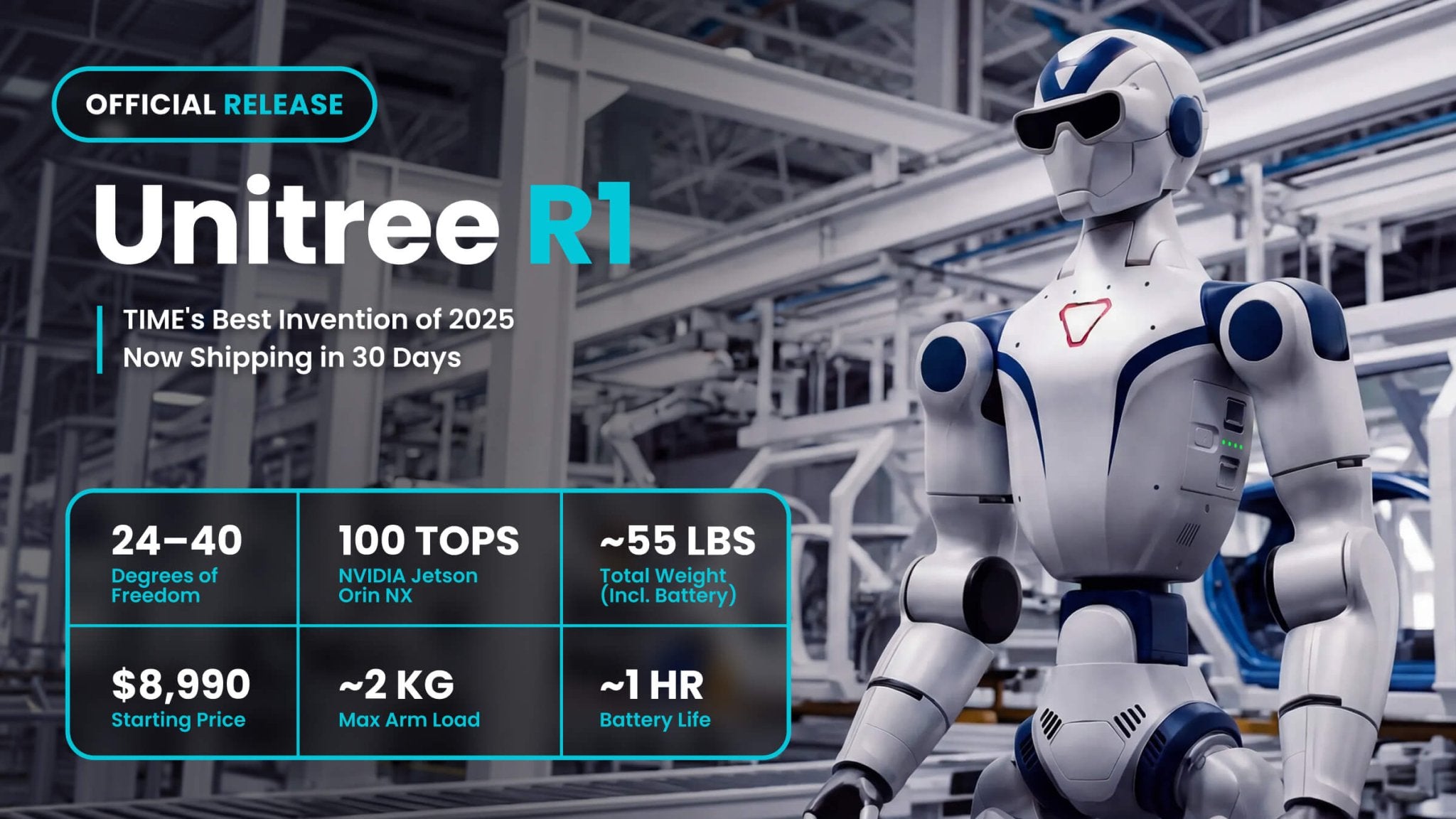
Out of roughly 14,600 humanoid robots shipped globally in 2025, Unitree shipped more than 5,500 of them, representing approximately 38 percent of the global humanoid market.
That's important because it means Unitree is not just showcasing robots. They are manufacturing, delivering, and supporting them at real scale.
It also highlights an important market distinction. While some companies have shipped more units globally, many of those robots remain concentrated outside the United States or are only available through limited enterprise programs. Unitree, by contrast, offers commercially available humanoids in the US today.
Through RoboStore, customers also gain:
-
Localized US-based sales and support
-
Technical guidance from a real robotics team
-
A clear path from evaluation to deployment
Production today beats promises tomorrow.
Honorable Mention: Quadrupeds and Broader Robotics Leadership
While this article focuses on humanoids, it is worth stepping back and looking at robotics more broadly.
In the quadruped category, Unitree has been one of the most dominant players globally. Independent market analysis estimates that Unitree has accounted for roughly 70 percent of global quadruped robot sales, with more than 23,700 quadruped units shipped in 2024 alone.
Platforms like the Unitree Go2 have become some of the most widely adopted quadrupedal robots in the world, particularly across education, research, and enterprise applications. Alongside it, larger industrial platforms like the Unitree B2 highlight the full spectrum of quadruped capability, offering higher payloads and durability suited for demanding environments. That breadth reflects a consistent focus on production readiness, accessibility, and real-world deployment.
Taken together, Unitree’s leadership across both humanoid and quadruped platforms underscores its position at the forefront of modern robotics.
The Bottom Line
CES 2026 confirmed that humanoid robots have officially arrived. What it did not do was flatten the gap between demos and deployable systems. The real divide in robotics today is between prototypes, pilots, and platforms that are actually shipping at scale.
Only a handful of companies have crossed that threshold, and Unitree stands out as one of the few with production-ready humanoids available in the United States. If you’re ready to move beyond demos and actually deploy a humanoid robot, RoboStore is the place to start.
As Unitree’s largest and most established U.S. partner, RoboStore provides direct access to real hardware, with real people helping you with your purchase every step of the way.

Sources and References
- Unitree Robotics, Clarification Regarding Unitree’s 2025 Sales Data (Official Statement) https://www.linkedin.com/posts/unitreerobotics_clarification-regarding-unitrees-2025-sales-activity-7420072163086520321-AKeu/
- Omdia, Global Humanoid Robot Shipments 2025
https://www.prnewswire.com/news-releases/omdia-ranks-agibot-no1-worldwide-in-humanoid-robot-shipments-in-2025-302656788.html - Forbes, Top Humanoid Robot Companies by Shipments
https://www.forbes.com/sites/johnkoetsier/2026/01/09/top-10-humanoid-robot-companies-by-shipments-revealed/ - South China Morning Post, Chinese Firms Dominate Humanoid Shipments
https://www.scmp.com/tech/tech-trends/article/3339346/ - VNExpress, AgiBot Tops Global Humanoid Shipments
https://e.vnexpress.net/news/tech/tech-news/china-s-agibot-tops-global-humanoid-robot-shipments-in-2025-5004681.html - 36Kr, Unitree Quadruped Sales and Market Share
https://eu.36kr.com/en/p/3569518540020104 - SemiAnalysis, Quadruped Robotics Market Overview
https://newsletter.semianalysis.com/p/quadruped-state-of-the-market-unitree - Reuters, Mercedes-Benz Pilots Apptronik Humanoid Robots
https://www.reuters.com/business/autos-transportation/mercedes-benz-takes-stake-robotics-maker-apptronik-tests-robots-factories-2025-03-18/ - Figure AI, BMW Production Pilot Announcement
https://www.figure.ai/news/production-at-bmw - Boston Dynamics, Atlas Humanoid Overview
https://www.bostondynamics.com/atlas - Wired, The Year of the Humanoid Robot Factory Worker
https://www.wired.com/story/2025-year-of-the-humanoid-robot-factory-worker/

Share:
CEO Ted Haggerty and Humanoid KOID Featured on CNBC
Training Robots in Simulation: Why It Matters Before Deployment