

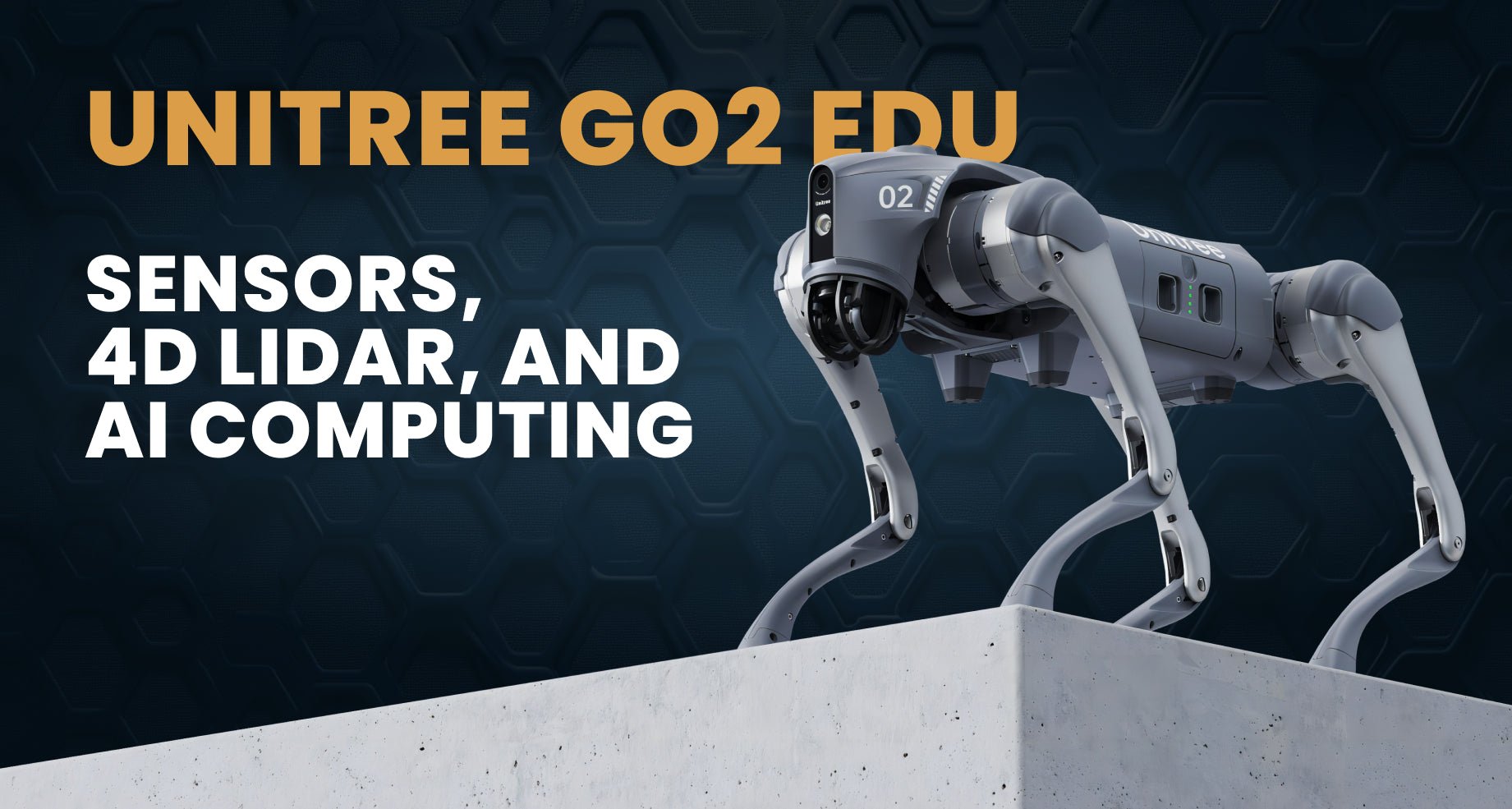
Explore the sensor technology and onboard computing power of the Unitree Go2 EDU quadruped robot. Learn how 4D LiDAR, HD cameras, voice features, and NVIDIA Jetson AI modules enable autonomous navigation and smart robotics.
4D LiDAR L1: Omnidirectional Environmental Awareness
One of the standout features of the Unitree Go2 EDU is its rich suite of advanced sensors, which empowers the robot with exceptional perception, obstacle detection, and intelligent navigation. At the core of the perception system is Unitree’s self-developed 4D LiDAR L1, offering a 360° × 90° field of view for full-surround sensing. This spinning LiDAR scanner delivers:
- Dense environmental point cloud mapping
- Minimum detection distance of just 5 cm, eliminating blind spots
- High-resolution obstacle detection for “all-terrain” mobility

The 4D LiDAR data integrates seamlessly with SLAM (Simultaneous Localization and Mapping) tools, allowing users to generate accurate 3D maps and set up autonomous navigation missions via the Unitree Go2 app.
HD Wide-Angle Camera for Visual Perception
The Go2 EDU also includes a front-facing HD wide-angle camera with:
- 1280×720 resolution
- 120° field of view (FOV)
This camera enables teleoperation with real-time video, and supports computer vision tasks such as object detection, person tracking, and environmental recognition using AI algorithms.

Multi-Modal Sensor Integration
Beyond LiDAR and vision, the Go2 EDU includes:
- Inertial Measurement Unit (IMU) for precise balance and orientation
- Microphone and speaker system – supporting voice commands and two-way audio (intercom mode)
- Wireless Vector Tracking Module (ISS 2.0) – improves side-follow tracking accuracy by 50% and enables reliable human-following at >30 meters range
This combination enables adaptive movement, voice-based interactions, and enhanced user-following functionality in real-world scenarios.
AI Edge Computing: Built for Intelligent Autonomy
What truly sets the Go2 EDU apart is its onboard AI computing capability, enabling edge processing without dependence on external systems.
Standard Configuration:
- 8-core ARM CPU for locomotion and base-level control
-
Suitable for basic perception, walking algorithms, and low-latency control tasks
EDU Upgrade Options:
|
Computing Module |
Performance |
Use Case |
|---|---|---|
|
Jetson Orin 40 TOPS |
Mid-range AI performance |
SLAM mapping, basic CV tasks, real-time moderate AI workloads |
|
Jetson Orin 100 TOPS (Orin NX) |
High-end AI powerhouse |
Neural networks, face/object recognition, complex autonomy |
With up to 100 TOPS (Tera-Operations Per Second), the robot can run advanced neural networks, real-time mapping, and vision AI algorithms directly onboard — perfect for autonomous robotics research.
Real-Time Control and ROS Compatibility
- The Go2 EDU runs Unitree’s custom firmware with support for Robot Operating System (ROS) frameworks.

Share:
Unleashing Mobility and Power: Go2 EDU Quadruped Robot’s Advanced Actuation System
Humanoid Robots in Hospitals: Are We on the Brink of a Robotic Healthcare Revolution