


Introducing RoboUniversity’s New G1 Humanoid Motion Course
RoboUniversity has officially launched its latest robotics training course: G1 Humanoid Motion Generation with Kimodo.
Built for developers, robotics teams, and educators working with the Unitree G1 humanoid robot, this course breaks down one of the most exciting recent advancements in humanoid motion generation: Kimodo, NVIDIA’s controllable motion diffusion framework for generating robot movement from natural language and structured constraints.
As humanoid robotics development accelerates, tools like Kimodo are becoming increasingly important for creating expressive, deployable robot motion. This course was built by the team at RoboUniversity to make that workflow practical, understandable, and directly applicable to real-world G1 deployment.
Why This Course Matters Right Now
Kimodo is a controllable motion diffusion model that can generate human and robot motion from natural language while still allowing the user to steer the result with constraints, keyframes, paths, waypoints, and timeline edits.
That is what makes the project compelling. It is not just text-to-motion. It is motion authoring with control.

As humanoid robotics development continues to accelerate, tools like Kimodo are changing how motion is created, tested, and deployed. Instead of manually scripting every movement from scratch, developers can generate complex motion sequences faster, iterate more efficiently, and refine outputs with far more flexibility.
That shift matters, especially for teams working with platforms like the Unitree G1 humanoid robot, where motion quality, timing, and deployability directly impact real-world performance.
That is exactly why RoboUniversity built this course.
This training was created to make Kimodo’s workflow understandable and practical for learners, robotics operators, and development teams who want to use it in real applications, not just experiment with it in theory.
Beyond generation itself, the course also shows how exported motions are prepared for deployment and how that workflow connects to getting movement onto the real Unitree G1 humanoid robot.
Because understanding the tool is one thing, but deploying it is where the real work begins.
Who Created Kimodo And When It Arrived
Kimodo comes out of NVIDIA's broader humanoid motion and physical AI research effort. The initial open-source release landed on March 16, 2026.
That first public release included five model variants across SOMA, G1, and SMPL-X, along with command-line tools, the interactive demo, and timeline annotations for BONES-SEED.
The project then evolved quickly with a breaking update on March 19, 2026, a benchmark and v1.1 release on April 10, 2026, and additional improvements on April 24, 2026.
The Real Appeal Of Kimodo
Kimodo combines text-driven motion generation, timeline-based authoring, kinematic constraints, interactive browser editing, and export paths that connect motion generation to downstream robotics workflows.

This makes Kimodo more than a research artifact. It becomes something people can inspect, iterate on, and build into a larger production or robotics pipeline.
Why This Course Was Worth Making
A good course translates the repository into an understandable experience.
A learner should come away understanding:
- What Kimodo is for in a G1 workflow
- How prompts and controls work together
- How generated motion can be exported and used downstream
- How the workflow leads to deployment on the real G1 robot
- Where Kimodo fits in a larger robotics pipeline
More Than A Demo
The Kimodo README shows how motions can be visualized in MuJoCo, tracked in ProtoMotions, retargeted with GMR, and used alongside GEAR-SONIC. That makes Kimodo feel like an entry point into a larger humanoid motion workflow.
 Shown Above: Generated G1 motion visualized in MuJoCo.
 Shown above: Kimodo motion connected into a broader GEAR-SONIC workflow.
From Generation To The Real Unitree G1 Robot
This course does not stop at authoring motion inside the demo. It also shows how exported motions are prepared for deployment, converted into the required format, and connected to actual G1 robot playback.
A real deployment clip showing the Unitree G1 disco dancing is included in the share package as:
That example makes it clear that the course is not only about screens and interfaces. It is about getting movement onto the real robot.
Who This Course Helps
This course is useful for learners who want a clearer entry point into motion generation, robotics teams who need a practical explanation of the G1 workflow, and educators or internal teams who want a clean way to introduce Kimodo to others.
The Opportunity
Kimodo already has the ingredients of an excellent learning experience: a strong research foundation, a polished demo, meaningful constraint support, export paths, and visible connections to real robotics applications.

What the course adds is coherence. It helps people understand not only what Kimodo can do, but why those capabilities matter, how they connect, and how generated movement can ultimately be prepared for the real G1 robot.
Start Building with G1 Motion Generation
For teams and developers working with humanoid robotics, motion generation is quickly becoming a core skill.
This course gives learners a practical path into one of the most advanced motion generation systems currently available for the Unitree G1 humanoid robot.
If you already have a G1, this course helps you move faster.
If you are still building your robotics stack, RoboStore offers U.S.-based access to the Unitree G1 humanoid robot along with full access to the RoboUniversity curriculum ecosystem.
 Explore the full training ecosystem:

Share:
Training Robots in Simulation: Why It Matters Before Deployment
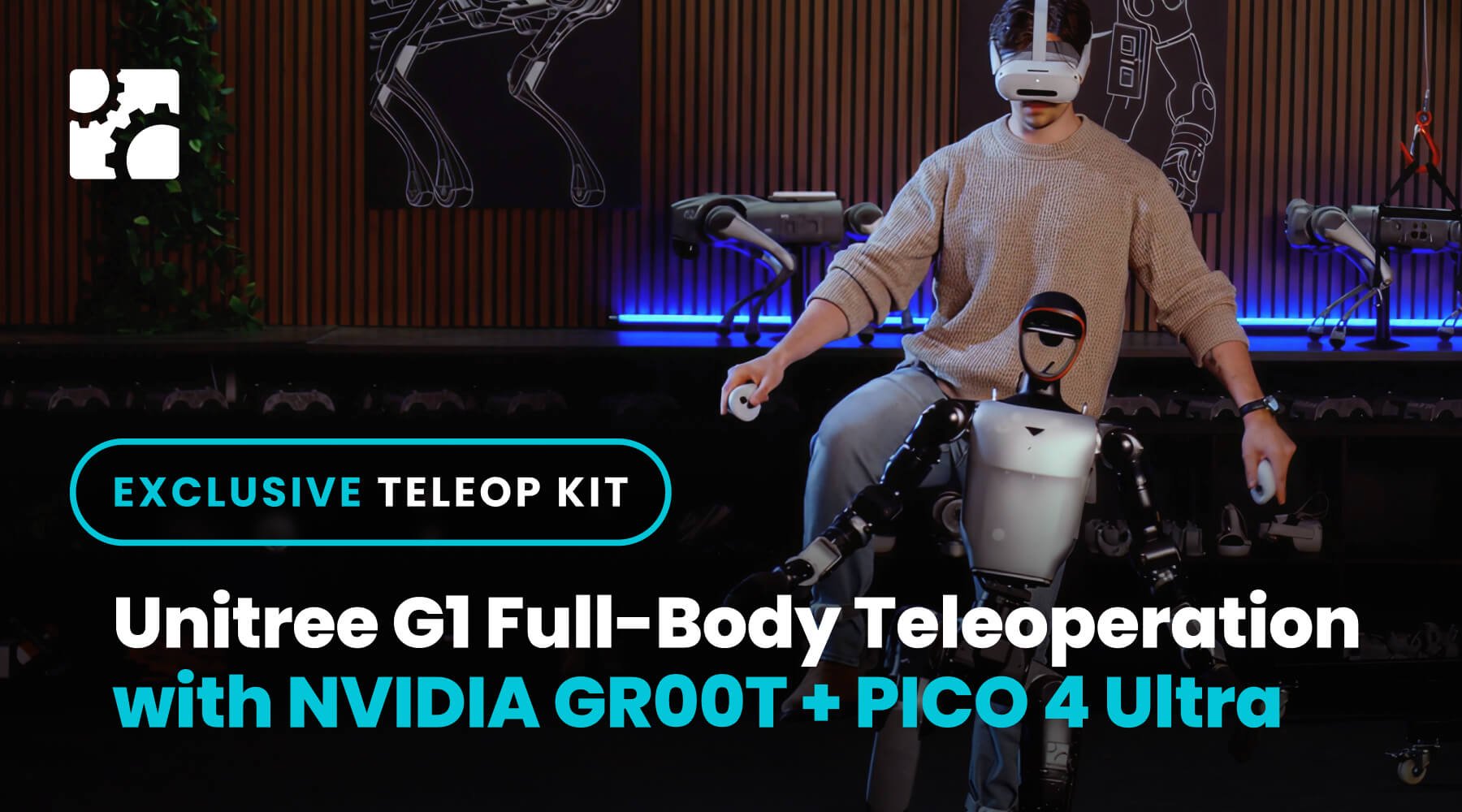
Unitree G1 Full-Body Teleoperation Kit with NVIDIA GR00T + PICO 4 Ultra